
Opening the Door
Some thoughts on revision

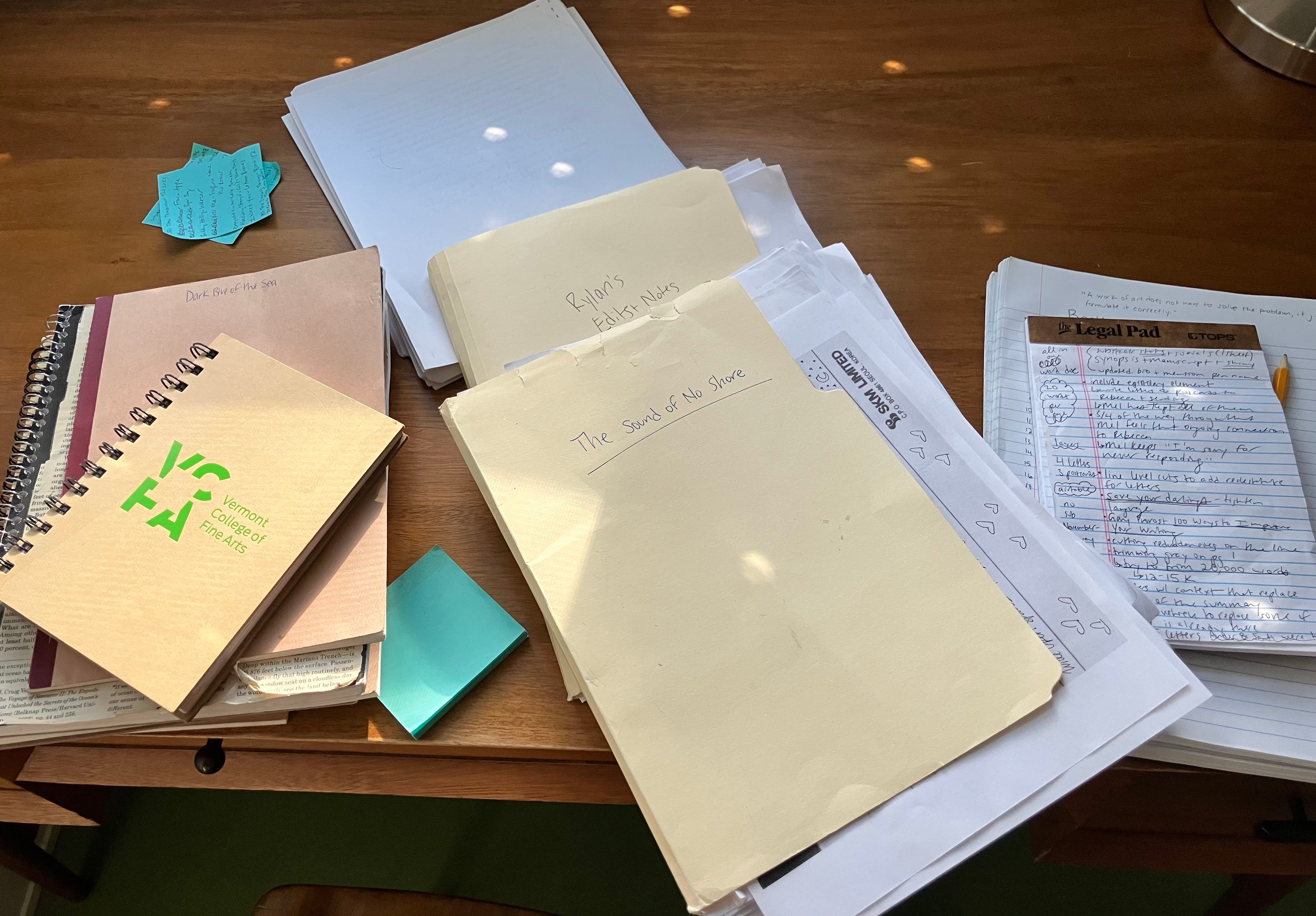
I do not enjoy drafting. I attended a low-residency MFA program that centered around drafting new work. We switched advisors every semester and did lots of experimentation. It was challenging for me to say the least. I’m a slow writer and ultimately do best when I follow the ol’ Stephen King adage, “write with the door closed, rewrite with the door open.”
Drafting my novel, The Sound of No Shore, took me over seven years. In those seven years I wrote other books and finished my MFA and spent a lot of time teaching. But the level of blank-page-paralysis I felt was, at times, colossal. I lost faith in myself as a writer. I lost faith in the project. It wasn’t until I switched to drafting longhand that the writing really started to flow. Writing longhand was so easy, in fact, that I wrote about ninety thousand words too many and had to do a whole lot of cutting.
I finished the novel at Hewnoaks Artist Residency in rural Western Maine. If you make art of any kind you should apply. I’m not a very woo person but I can’t reach for a better word to describe Hewnoaks than “magical.” Hewnoaks is also quite remote, with no internet or cell service. So I finished typing up my novel four days into a weeklong residency and thought…well now what? For a day I read on the dock and wrote some poetry and ran on the nearby trails. Then I drove an hour to the nearest Staples and spent far too much money printing out the beast of a manuscript.
It was at this point that I realized I had no idea what to do. How does one revise a whole book? I knew how to edit. I knew how to integrate feedback. I knew how to polish. But I didn’t know how to break the story open and figure out what worked and what didn’t. Even now, having spent the better part of a year revising my book, I’m not quite sure how to clearly articulate what the work of revision truly is.
But, since I’m teaching a class on revision this summer, let’s take a whack at it, shall we?
Here were my steps:
Print the whole thing out. This will be expensive if you go to Staples. But even if you don’t have access to an industrial printer, shell out for the printed pages. It’s worth it to hold the whole thing in your hands. It’s worth it to feel its heft and leaf through the pages. It also makes every single step I’m going to detail below 25x easier. I have printed my novel in full three separate times over the course of this revision process and I like to think that the dead trees really are worth it here.
Find your reader. Start with one. Mine was my wife, a journalist and generally brilliant human being. She reads a lot of fiction and has smart things to say about it. I know her aesthetic tastes are in line with mine and that she’s not going to give me “what if your book was a whole other book” kind of advice. If you have access to said industrial printer or have the funds, print out a copy for this reader too. Ask them to give you notes and give them a few questions to guide them. Suggest a deadline for getting your feedback (this is more for your benefit than theirs!)
Give your project some space. A lot of writing advice says to “put it in the drawer” for a few weeks or even a month. I don’t think there’s a magic timeline here. What worked for me was giving my novel to my wife, asking her how long she needed to read it, and working on a different project during that time. I figured her feedback wouldn’t be helpful if I’d been tweaking the story as she read. So for the month or so it took to get that first round of notes, I outlined a different novel and did some research. I poured my creative energy into a different bucket.
Accept feedback. I say this with a big caveat. There are helpful notes and unhelpful notes. Helpful notes are usually questions that crack open something big or help you see your project in a new way. Helpful notes start from an understanding of what you are trying to do with your project. Helpful notes are specific, clear, and honest. Unhelpful feedback, for me, mostly falls into the category of “what if.” Instead of asking specific questions about what you were trying to say or do in a scene, “what if” notes push your project in the direction of another person’s taste. Not all “what if” notes are unhelpful! Get your feedback in waves and sit with it. Don’t be reactive.
Make a plan. For me, writing is like oil painting. You do it in layers, first blocking out the colors and big shapes. You might need to take out big things or change the whole perspective. Then, slowly, you build. You add detail. You refine. For me this looks like this: story/plot first, character next, then flow and pacing, finally tightening and refining language. I don’t do these all as individual passes but I do tend to work out plot problems and work to enrich character before I worry about varying sentence length and doing a Control F for words like “just.”
Be okay with it taking time. I set deadlines for myself a lot. I would say I’m medium at sticking to them. Ultimately, I don’t think revision is a fast process. At least not for me. But it is my favorite part.
Unlearn and relearn. Garth Greenwell says it much better than I could:
There are no toolkits; the solutions we find are inventions of the moment, conjured by the exigencies of the problems we encounter, which are always particular to a project. We can’t take our tools with us, and this is why every artist I know, beginning a novel or poem or piece of music, feels like they’re starting anew, from a position of utter ignorance. What an artist needs is not to learn a set of rules or replicable problem-solving steps—things that, inculcated, often mean years lost getting rid of them—but instead the cultivation of a problem-solving intelligence.
If you want to know more of my thoughts on revision…I’m teaching a class about the process with Maine Writers and Publishers this summer. Here’s the description and a link if you want to nerd out about structure, polishing, and beautiful sentences with me.
Polishing Your Piece for Print: A One-Day Power Revision Workshop
So you have a first draft. Congratulations! But...now what? Revision can seem like a daunting process. In this one-day intensive workshop we will demystify the work of revision, focusing on: making broad structural changes, integrating feedback, deepening character development, and granular sentence-level polishing. Through exercises, mentor texts, and craft discussions we will collaborate to make your draft shine for publication. This one-day workshop is suited to writers of all levels looking to get a fresh perspective on an existing draft.
Oh! Two of my friends wrote books and you should read them!
My friend Brianna’s book Under a Carnivore Sky is out today! Brianna is brilliant and her book is a YA novel in verse about a carnivorous swamp…I mean COME ON!
I was lucky enough to read a draft of Grafting by Rylan Hynes and was so moved by their gorgeous prose and this absolutely gutting queer love story.